Pool Maintenance Cost in 2026: The Real Yearly Number
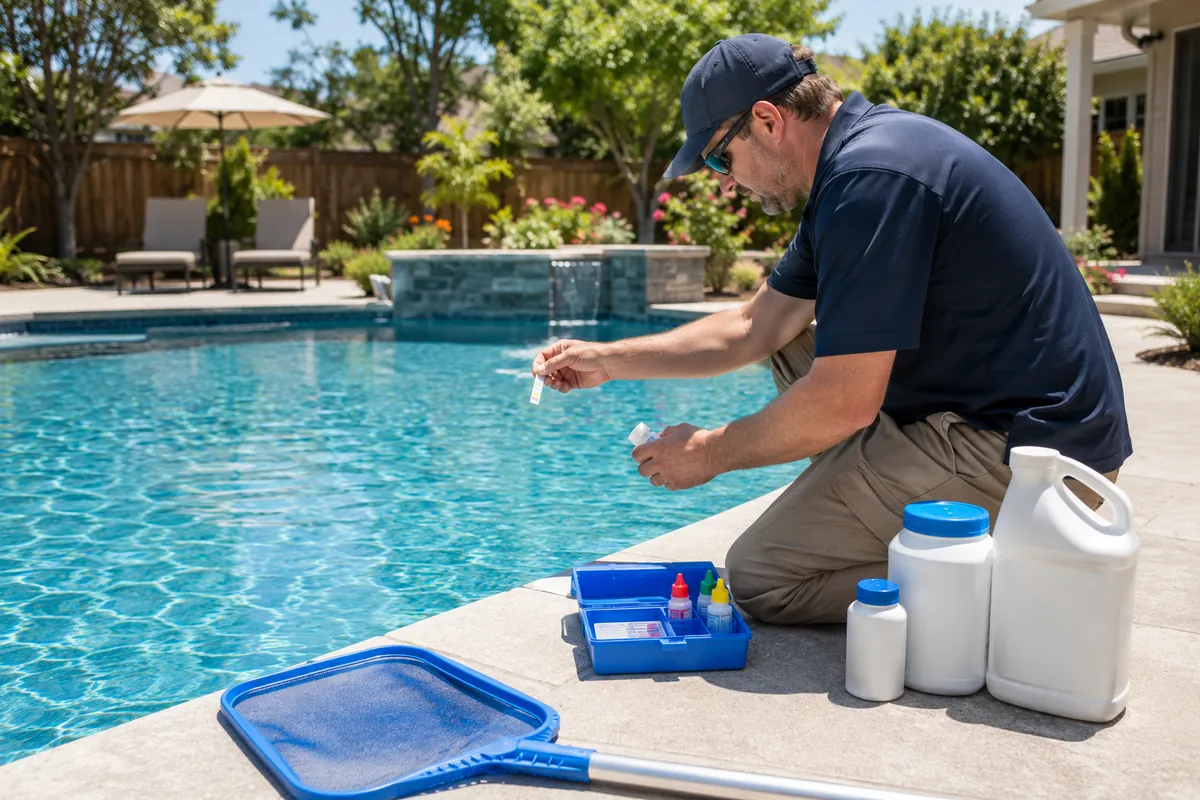
Pool maintenance cost: owning an inground pool runs most homeowners between $1,200 and $3,500 a year if you do the work yourself, and $3,000 to $6,000 a year if you hire a weekly service, before you hit a major repair. Almost nobody budgets for it before they build, and that's the mistake I want you to avoid.
I build pools for a living, 17 years now, and I tell every homeowner the same thing before we dig: the pool is the down payment, the upkeep is the mortgage. A pool is a great thing to own. It's also a recurring bill, and the people who hate their pool are usually the ones who got surprised by that bill. So let me lay out the real annual cost, line by line, the way it actually shakes out.
The Big Choice: Service vs DIY
Your first fork is whether you pay a pool service or do it yourself. This is the biggest single swing in your yearly number.
| Approach | Typical annual cost | What you're trading |
|---|---|---|
| Weekly professional service | $1,400 to $3,600 (service only) | Money for time; they handle chemistry and cleaning |
| DIY | $600 to $1,800 (supplies only) | Time and learning for savings |
Weekly service in most markets runs $100 to $300 a month depending on your region and pool, and that's usually just labor and basic chemicals, with repairs and the occasional shock or specialty chemical billed on top. DIY is dramatically cheaper in dollars but costs you a few hours a week and the willingness to learn water chemistry. Neither is wrong. Just know which one you're signing up for.
One thing I'll add from watching hundreds of owners: the people happiest with a service are the ones who travel a lot, have a busy season at work, or simply don't want a chore on the calendar. The people happiest doing it themselves are the ones who don't mind a Saturday-morning rhythm and like understanding their own pool. Cost is only half the decision. Be honest about your patience, because a neglected DIY pool turns green and then costs more to recover than a year of service would have.
Chemicals: Sanitizer, Balancers, and Shock
Whether you DIY or just want to understand your service bill, here's where chemical money goes for a standard 15,000 to 20,000 gallon pool over a season.
- Chlorine (tablets or liquid): $200 to $500 a year for a chlorine pool.
- Balancers (pH, alkalinity, calcium hardness): $100 to $250 a year.
- Shock for weekly or after-storm treatment: $100 to $200 a year.
- Algaecide and specialty stuff as needed: $50 to $150.
The cheapest way to waste money on chemicals is to dose blind. You can't balance what you don't measure. Get a real pool water test kit instead of guessing, and if you want fast everyday checks, pool test strips are fine for a quick read between full tests. Balanced water also protects your surface, so this is double savings: less wasted chemical now, less plaster etching or liner damage later. For bulk dosing, buying pool chemicals in season beats one-off trips to the store.
If you're weighing a salt system to cut the chlorine line, run the full math in saltwater vs chlorine first, because salt has its own recurring cost.
Electricity: The Pump Is the Hidden Bill
This one shocks people. Your pool pump and, if you have it, your heater are real draws on your power bill.
- Single-speed pump running daily: easily $40 to $80 a month in many markets. Over a season that's a few hundred dollars, and it can be the second-biggest pool expense after a heater.
- Variable-speed pump: the upgrade pays for itself. Running on low for longer cycles can cut pump electricity by 50 to 80 percent. If you're still on a single-speed, swapping to variable-speed is the best ROI move in pool ownership.
- Heater: a gas heater can burn $200 to $500 a month when you're actually running it, which is why most folks heat only the shoulder seasons. A heat pump is cheaper to run but slower.
Annual pump-and-heat electricity for a typical pool with moderate heating: figure $400 to $1,200.
Water: Evaporation, Splash-Out, and Backwash
You'll add water all season. Evaporation, splash-out, and backwashing a sand or DE filter all pull the level down. For most pools the refill water is a modest line, often $50 to $200 a year depending on your water rate and climate. Hot, dry regions and a lot of swimming push it higher. It's small, but it's not zero, and it's part of the honest number.
Opening and Closing (Seasonal Climates)
If you're somewhere with a real winter, you open and close the pool each year.
- Professional closing: $150 to $400. Blowing out lines, adding winter chemicals, setting the cover.
- Professional opening: $150 to $400. Reversing all of that and getting the water swimmable.
- DIY: mostly your time plus winter chemicals and a cover that lasts several seasons.
Call it $300 to $800 a year for the seasonal dance if you hire it out, much less if you DIY. Warm-climate pools that run year-round skip this but trade it for more pump runtime and more chemicals across twelve months instead of six.
Cleaning: Robotic vs Manual
You can vacuum and brush by hand, or let a machine do it. Over a season this is a time-versus-money call, not unlike the service decision.
A robotic pool cleaner is the single best quality-of-life purchase for a pool owner who does their own maintenance. It scrubs the floor, walls, and waterline on its own while you do something else. A good one runs a few hundred dollars and lasts years. The alternative is a manual setup: a pool skimmer net and pole for surface debris plus a manual vacuum head, which is cheaper but means you're out there pushing it yourself. Either way you'll still want a skimmer net for leaves and bugs, because no robot catches everything floating on top.
The Repair Reserve Nobody Sets Aside
Here's the line item that turns a "$1,500 a year" pool into a "$4,000 this year" pool: equipment doesn't last forever, and when it goes, it's not cheap.
- Pump motor or full pump: $300 to $1,500.
- Filter (cartridge, sand, or DE) service or replacement: $100 to $1,000.
- Heater repair or replacement: $500 to $5,000.
- Salt cell replacement (salt pools): $300 to $900 every 3 to 7 years.
- Liner replacement (vinyl pools): $3,500 to $6,000 every 7 to 12 years.
- Replaster (gunite pools): $5,000 to $12,000 every 10 to 15 years.
You won't hit all of these every year, but you'll hit something eventually. I tell homeowners to set aside $300 to $800 a year as a repair reserve. The pump that dies in year five didn't come out of nowhere; it came out of the budget you should have been building. Which type of pool you own changes this reserve a lot, so factor it in before you build. My gunite vs fiberglass vs vinyl breakdown covers how the surface choice drives long-term upkeep.
Putting It All Together: The Real Annual Cost
Here's a realistic full-year picture for a standard 18,000 gallon inground pool in a four-season climate.
| Line item | DIY | Hired service |
|---|---|---|
| Chemicals | $450 to $1,000 | included in service |
| Weekly service | n/a | $1,400 to $3,600 |
| Electricity (pump + some heat) | $400 to $1,200 | $400 to $1,200 |
| Water | $50 to $200 | $50 to $200 |
| Opening and closing | $50 to $150 | $300 to $800 |
| Repair reserve | $300 to $800 | $300 to $800 |
| Realistic yearly total | $1,250 to $3,550 | $2,450 to $6,600 |
Warm-climate pools shift money around (no closing, more pump runtime) but land in similar territory. The point stands: budget a few thousand dollars a year, every year, for as long as you own the pool.
A lot of that chemical money is really about keeping the water safe to swim in, not just clear. The chlorine and pH ranges you're paying to maintain are the same ones public-health guidance points to for killing germs, and the CDC healthy swimming pages explain why proper free chlorine and pH actually matter beyond just looking nice. Balanced water is a health line item before it's an aesthetic one.
Frequently Asked Questions
How much does it cost to maintain a pool per year?
Owning an inground pool runs most homeowners $1,200 to $3,500 a year if you do the work yourself, and $3,000 to $6,000 a year if you hire a weekly service, before any major repair. The biggest single swing is whether you DIY or pay for service. Either way, budget a few thousand dollars a year for as long as you own the pool.
Is it cheaper to maintain a pool yourself or hire a service?
DIY is dramatically cheaper in dollars, often $600 to $1,800 a year in supplies versus $1,400 to $3,600 for weekly service, but it costs you a few hours a week and the willingness to learn water chemistry. Service is worth it for people who travel, have a busy work season, or just don't want a chore on the calendar. Be honest about your patience, because a neglected DIY pool turns green and costs more to recover than a year of service would have.
What is the most expensive part of pool maintenance?
On a normal year, professional service or a gas heater's running cost are the biggest lines. But the expense that ambushes people is repairs: a pump is $300 to $1,500, a heater $500 to $5,000, a salt cell $300 to $900 every few years, a liner $3,500 to $6,000, a replaster $5,000 to $12,000. Set aside $300 to $800 a year as a repair reserve so the pump that dies in year five comes out of a budget, not out of nowhere.
How much does pool electricity cost per month?
A single-speed pump can easily run $40 to $80 a month, and a gas heater $200 to $500 a month when you're actually running it. Switching to a variable-speed pump cuts pump electricity by 50 to 80 percent and is the best ROI move in pool ownership if you're still on single-speed. Figure $400 to $1,200 a year for pump-and-heat electricity on a typical pool with moderate heating.
Does a fiberglass pool really cost less to maintain?
Yes, meaningfully. The non-porous gelcoat resists algae, so you burn fewer chemicals, and there's no liner to replace and no replaster, which removes two of the biggest recurring repair lines other pool types carry. If the yearly maintenance number scares you, a fiberglass surface is one of the clearest ways to bring it down.
How much does opening and closing a pool cost?
In a four-season climate, professional closing runs $150 to $400 and opening another $150 to $400, so call it $300 to $800 a year if you hire it out, much less if you DIY. Warm-climate pools skip this but trade it for more pump runtime and more chemicals across twelve months instead of six.
What This Means for You
A pool is worth it. I've built hundreds and I'd build my own again. But go in clear-eyed: the build cost is the start, and a few thousand a year is the forever cost. If that number scares you, a smaller pool or a fiberglass surface (lower chemicals, no liner) brings it down meaningfully.
Before you sign a build contract, look at the maintenance number alongside the build number so the total ownership cost is in front of you, not behind you. The inground pool cost guide covers the build side, and between the two you'll have the full picture. When you're ready to build, find a reputable builder who'll size and equip the pool for low upkeep, not just a low quote, and builders, you can get listed to reach owners planning ahead.